
Views: 0 Author: Site Editor Publish Time: 2026-09-04 Origin: Site
As grain is held after harvest, temperature control becomes an important part of protecting storage quality. Warm grain can create conditions that support insect activity, moisture migration and fungal development, especially when storage periods are extended. For this reason, grain operators are looking beyond basic aeration and evaluating dedicated cooling equipment for bulk grain silos and grain warehouses.
A silo grain cooler for corn and wheat storage is designed to deliver conditioned air through a grain handling system so that stored grain can be cooled in a more controlled and repeatable way. CSTHEATEXCHANGER presents its Grain Cooler as part of its Unit Cooler product range and also offers a mobile grain air cooler for bulk grain storage silos, flat grain warehouses and grain processing workshops. The product information identifies wheat, corn, rice and soybeans as suitable storage applications, while the final system configuration is determined by the grain, storage volume, airflow arrangement and local operating conditions.
Cooling does not replace proper drying, moisture testing or routine inspection. Instead, it works as one part of a complete grain storage program. Grain should enter storage at a moisture level suitable for the intended storage period, and operators should continue checking temperature and moisture after loading. Cooling equipment then helps remove excess heat and reduce temperature differences within the grain mass.
Agricultural storage guidance from AHDB recommends beginning cooling as soon as grain enters storage. Its guidance explains that cooling can help reduce insect activity, limit moisture translocation and improve the safe storage period. The same guidance also recommends regular temperature monitoring, with measurements taken in locations that are slowest to cool. North Dakota State University Extension likewise advises operators to keep stored grain cool and dry during summer storage because warmer conditions can accelerate insect activity and mold growth.
For corn and wheat operators, the practical objective is not simply to make the grain cold. The objective is to establish a stable and measurable storage environment. A well-planned grain cooling system can help reduce hot spots, equalize temperatures and make the storage program easier to monitor. The target temperature and operating schedule must be selected according to grain moisture, climate, storage duration, crop condition and the recommendations of the equipment supplier or grain storage specialist.
A silo grain cooler conditions air before it is introduced into the grain storage system. Depending on the installation, cooled air can be delivered through perforated ducts, aeration floors or other compatible air distribution components. The air then moves through the bulk grain, carrying away heat and gradually creating a cooling front.
The quality of the result depends on more than the cooling unit alone. Airflow resistance, grain depth, duct spacing, fan pressure, sealing and sensor placement all influence the cooling process. AHDB notes that grain depth and duct spacing should be considered together, because deeper grain beds require an appropriate air distribution design. The organization also explains that differential controls can reduce unnecessary fan operation by starting cooling when ambient air is cooler than the grain.
A dedicated grain cooler can be useful when ambient air is too warm, too humid or too inconsistent to provide the desired storage conditions. Instead of relying only on outdoor air, the operator can use conditioned air as part of a planned cooling cycle. This approach is particularly relevant during warm harvest periods or in regions where night-time ambient temperatures do not fall enough to cool the grain effectively.
The system should be operated with monitoring in place. Temperature cables, calibrated probes or other approved sensors can help identify whether the cooling front has reached the required areas. Operators should also inspect the grain surface, roof space, ducts and fan inlets for condensation, dust accumulation or airflow problems.

Corn and wheat do not always have identical storage requirements. Their moisture content, bulk density, kernel condition and intended storage duration may differ, so a grain cooling system should not be selected from capacity alone. The project team should define the crop, expected throughput, maximum grain depth, storage vessel dimensions and seasonal operating profile before finalizing the equipment.
For corn storage, the cooling program may need to address heat retained after drying, warm weather during summer and temperature differences between the center and the outer wall of a silo. For wheat storage, operators may focus on preventing hot spots, maintaining stable conditions during long holding periods and ensuring that airflow reaches the full grain bed. In both cases, cooling should be coordinated with moisture checks and grain inspection rather than treated as a one-time operation.
A silo grain cooler can support different operating strategies. Some facilities may cool grain soon after it is loaded. Others may use scheduled cooling cycles during seasonal changes or after temperature monitoring identifies a developing hot spot. The correct method depends on the site design and operating plan. Grain handlers should avoid running fans or cooling equipment blindly, because unsuitable air conditions, excessive aeration or poorly placed ducts can reduce efficiency and may contribute to condensation risk.
The key benefit is operational control. By combining a suitable cooler with air distribution and monitoring, a storage facility can make its cooling decisions based on measured grain conditions instead of relying entirely on outdoor weather.
Mobile Grain Air Cooler for Flexible Storage Operations
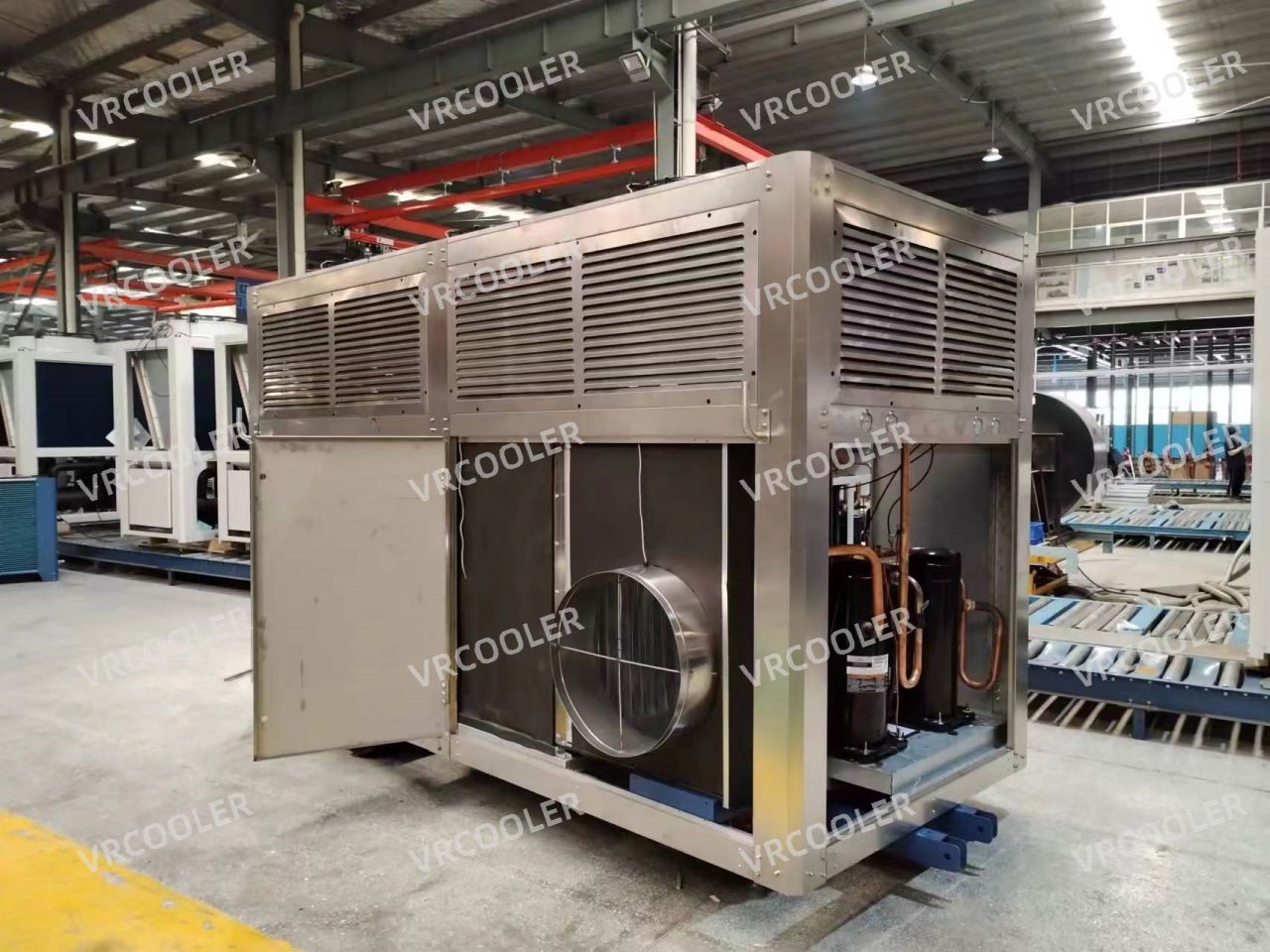
Not every facility has the same storage layout. Some operators manage multiple silos, flat warehouses and processing areas, while others need equipment that can be moved between storage locations. CSTHEATEXCHANGER’s mobile grain air cooler as a portable grain chiller for bulk grain storage silos, flat grain warehouses and grain processing workshops.
Mobility can be valuable for seasonal operations, shared equipment programs and facilities with several grain storage points. A portable unit may allow the operator to serve different bins or storage zones as required, provided that the air connections, power supply, ductwork and installation conditions are compatible. This can help avoid dedicating a separate cooling unit to every storage point, although the total site capacity and operating schedule must be evaluated before purchase.
A mobile configuration also makes it important to plan movement, connection and commissioning procedures. Operators should confirm access routes, floor loading, hose or duct connection points, electrical requirements, drainage arrangements and the distance between the cooler and each storage vessel. Dust control and routine cleaning are also important in grain-handling environments.
What to Check Before Selecting a Grain Cooling System
A reliable project begins with accurate operating data. Before requesting a quotation for a silo grain cooler for corn and wheat storage, grain operators should prepare the following information:
Crop type, grain condition and expected moisture range
Storage capacity, number of silos and maximum grain depth
Silo diameter, flat-store dimensions and available duct connections
Desired cooling schedule and expected storage duration
Local ambient temperature, humidity and seasonal conditions
Available electrical supply and installation location
Existing fans, aeration floors, temperature cables and control equipment
Required mobility, connection method and service access
Any requirements for drawings, documentation, testing or OEM adaptation
It is also useful to clarify how the supplier handles engineering changes. CSTHEATEXCHANGER can build heat exchangers for new jobs and replacement applications and provide design data and production drawings. These services may be relevant when a grain cooler must connect to an existing silo or when the customer needs a customized air-side arrangement.
CSTHEATEXCHANGER’s Engineering and Manufacturing Support
CSTHEATEXCHANGER team works with media including water, steam, refrigerant, glycol, ammonia and CO2, and that it produces both commercial copper-tube/aluminum-fin heat exchangers and heavier industrial heat exchangers for process applications.
We use European HVAC design software, has designed and exported coils and unit coolers to customers in different countries, and provides OEM/ODM services. According to the published quality information, products can be supplied with design data and production drawings, while coils are described as leak tested before delivery. These claims should be confirmed against the specific grain cooler quotation, inspection plan and project documentation for each order.
For grain storage projects, this engineering background matters because cooling performance is linked to the complete system rather than one isolated component. A practical solution may require coordination between the cooling unit, fan, duct, sensor, control and silo structure. Early technical communication can help identify connection constraints and avoid costly changes during installation.
The need for dependable grain conditioning continues as farmers, grain merchants and processors manage longer storage periods and more variable weather. A silo grain cooler for corn and wheat storage can provide a useful method for reducing grain temperature when ambient air alone is not sufficient. When integrated with correct moisture management, aeration design, temperature monitoring and regular inspection, it can support a more consistent storage program.
CSTHEATEXCHANGER’s Grain Cooler and mobile grain air cooler are positioned for bulk grain silos, flat warehouses and grain processing applications. The company’s public product range also includes unit coolers, industrial coils, air cooling units and related heat exchanger equipment, giving project teams a starting point for discussing customized cooling requirements.
Before selecting equipment, operators should share complete site and grain data and request a project-specific recommendation. For corn, wheat or other bulk grains, the right system is the one that matches the storage geometry, airflow path, cooling objective and operating environment. Contact CSTHEATEXCHANGER to discuss a grain cooling solution for a new installation, a replacement project or a multi-location storage operation.

